Showing posts with label documentary. Show all posts

Tuesday, December 16, 2014

...And That's a Wrap on VFF14


The Valley Film Festival (VFF) closes the curtain on another thought provoking, entertaining lineup of cinema so independent it could only be found in L.A.'s San Fernando Valley.

ODD BRODKSY and THE GREEN GIRL took home the top Narrative and Documentary Jury Awards, respectively, while WINDS AND STRINGS snagged both the Jury and Audience Awards for short film. Additional short film Audience Award winners included: ANY OTHER FRIDAY, SPIDORA, and TRACES OF MEMORY.

JURIED “10 DEGREES HOTTER” AWARDS:
Feature – ODD BRODSKY (Cindy Baer) 
Documentary - THE GREEN GIRL (George Pappy) 
Short – WINDS AND STRINGS (Ricardo Ultreras)

AUDIENCE AWARDS:
ANY OTHER FRIDAY (Peter Paul Basler) 
SPIDORA (Fred Olen Ray) 
TRACES OF MEMORY (Jody Jaress) 
WINDS AND STRINGS (Ricardo Ultreras)

The 5-day festival, which ran December 10-14 at Laemmle NoHo7, screened 45 of today’s most provocative films from 17 countries, such as Australia’s FLYBOY, the newest short film produced by Academy Award Nominee Drew Bailey (MIRACLE FISH, 2009) and BAGHDAD MESSI, a UAE-Belgium co-production, currently shortlisted for an Oscar.

With a mission further the education, production, and distribution of filmmaking in The Valley, VFF continues to promote local independent production with over fifteen films made by Angelenos, Vals, and shot in or about the glamorous San Fernando Valley this year. Valley-based filmmakers with an LA premiere were ROUTE 30 THREE, directed by John Putch (Cougar Town, Scrubs), SING YOUR OWN SONG: AN OPERA DOCUMENTARY from Anne O’Neal, and YOU OR A LOVED ONE, directed by Matt Mercer.

Founded in 2000, The Valley Film Festival, a non-profit project of Community Partners ®, is the first and longest continually running film festival in the San Fernando Valley. VFF has screened over 500 shorts, features, documentaries, animated films, experimental works, and music videos from around the world. While emphasizing independent film, the festival also screens studio productions, including BOOGIE NIGHTS, CHINATOWN, ENCINO MAN, FAST TIMES AT RIDGEMONT HIGH, MAGNOLIA, TERMINATOR 2, VALLEY GIRL, and WORLD TRADE CENTER. In addition to screenings, the Festival provides educational panels and networking opportunities throughout the year.

Looking ahead, The Valley Film Festival will begin accepting submissions for VFF15 in January. More information available at ValleyFilmFest.com 


Thursday, December 4, 2014

Eat, Drink, Opera: An Interview with Anne O’Neal about Her Film “Sing Your Own Song: An Opera Love Story”


Here at the festival, we always show some films that emphasize music as well as others made in or about Los Angeles.  One film that does both this year, and is an L.A. premiere, is Sing Your Own Song:  An Opera Love Story.  This feature-length documentary is about a niche culture in L.A., that of restaurants that regularly provide live opera performances.  I spoke recently with the film’s creator, Anne O’Neal, to find out more about it.

James Latham:  Not many restaurants feature live opera, but there are a lot of different places and situations where people listen to music while eating.  What do you think it is that makes food, drink, and music work so well together?

Anne O’Neal:  They’re all three sensual experiences that nourish us in different ways.  Music can fully engage our senses and also act like a film soundtrack by enhancing our feelings while enjoying good friends, good food, and good wine. 

JL:  What is it about opera in particular that makes it so appealing to the owners of these restaurants and their customers?

AON:  The co-owner of CafĂ© 322, Mario Lalli (featured in the film) grew up in an Italian family listening to opera, trained as an opera singer and then performed with New York City Opera. Many of the singers and audience members grew up with opera as part of their family tradition.  Patti Palumbo (a soprano and hairdresser who loves to sing as she works) had no thoughts of singing opera until she was discovered by a vocal coach while styling hair.  The emotions evoked by the music are timeless.  New or old passion, listener or performer, once opera catches your interest you get hooked.

JL:  Is this particular combination of food and art mostly an L.A. thing?  If so, why do you think that is?  Regardless, what are some of the local restaurants that you can recommend?

AON:  In the 1960s there was a very active opera scene centering around Sarno’s in Los Feliz.  World famous opera singers would stop in there after performances or concerts and just get up and sing as the spirit moved them.  There were also talented amateur singers who performed regularly, including Alberto Sarno the owner.  Several of the singers featured in the documentary met at Sarno’s.  Right now, there’s an open mic night Sundays at Olympus Greek Tavern in North Hollywood and Wednesday nights at Cucina Bene in Sherman Oaks for opera, show tunes, and pretty much whatever the crowd that night feels like singing.

JL:    Your film says a lot about the performers, from how they first got interested in opera to why they prefer this particular kind of venue.  While a restaurant venue may be relatively modest and obscure, the performers enjoy the benefits of a steady local gig that can work for them creatively as well as personally and professionally.  Young aspirants have a safe place to grow, while older artists with families and other commitments can enjoy the combination of creative outlet and life-work balance; and all of them can bond together.  Anyway, what do you think of all this?  

AON:   I was really drawn in by the story of how this diverse group of people, all different backgrounds and ages, had bonded together through their love of opera and become a second family.  The feedback from a live audience is an invaluable asset to any artist.  Accompanied by a wonderful pianist like Danny Guerrero, the younger singers have a chance to develop and expand their repertoire.  Many of the mature singers have sung professionally and now have moved on to other fields for various reasons.  They still have glorious voices and this type of venue gives them an opportunity to share their gift.  Part of the pleasure of filming the movie was seeing the mentorship of the younger singers by the more mature singers and the joy on the part of the audience members as the younger performers blossomed.

JL:  I think I saw the DVD cover for the movie Aria in the background of one or two shots in your film.  Several years ago, I saw that film with a friend who was a very knowledgeable opera lover.  The film consists of ten short pieces directed by different filmmakers; each piece is a sort of music video for a particular popular aria.  My friend hated the film for its MTV-inspired style as well as its “greatest hits” mentality of plucking individual songs from their original works and slapping them together out of context.  From your experience, what would you say to people who have rigid or elitist notions of what opera is, and how it should be presented to audiences?

AON:  Opera appreciation can take almost as much time and dedication as performing opera. But if you’ve ever seen a movie, a television show, or a commercial—you’ve enjoyed opera.  It probably is best to start listening to the more familiar pieces, even out of context, because you already know the melodies without realizing it.  My apologies to your friend, but if liking The Lone Ranger gets you interested in opera (the famous theme song is taken from the overture of the opera William Tell by Rossini) I think that’s great.  The idea of opera can be intimidating but the experience of opera is immediate, encompassing and emotional.  Even the smaller opera companies now project supertitles above the stage so you can follow what’s going on, and at the restaurants there always seems to be a friendly tablemate to fill you in on the details of an aria.

JL:  With the many challenges today facing both restaurants and opera, how optimistic are you about the long-term prospects of these particular restaurants?  Or even of opera itself?

AON:  Many small businesses, especially restaurants, are still feeling the effects of the economic downturn, so it’s hard to say.  The opera restaurants offer a great deal: dinner and a show for the price of a meal, so I hope they’ll be able to continue on.  Opera started as a popular art form and I think all the major opera companies are running special programs to make opera more available and accessible to a larger audience.  Opera’s been around for 400 years, so I’m crossing my fingers for at least 400 more.

JL:  Anything you’d like to mention that we haven’t already covered?

AON:  I started this film because a dear friend, Jenny Saraceno, told me about her wonderful friends and the good times they had singing opera at a local restaurant.  Jenny was an accomplished pianist in her own right, as well as teaching and leading the choral programs at Arminta School in North Hollywood for many years.  Sadly, Jenny passed away around this time last year.  Her passing made me think of all the young lives she touched and the joy in music that she had passed on to a younger generation.  At a time of drastic budget cuts, I think we all need to speak up for supporting arts education in the schools.  It’s important to learn the core curriculum, but I think arts education is equally important in helping us learn why we do things and what’s important in life.

JL:  OK, thanks for your time, and for sending us your film. 

AON:  Thank you.  I’ll get down off my soapbox now.  We’re all excited about Sing Your Own Song’s Los Angeles Premiere at The Valley Film Festival.  Hope to see you there!  

---
The 14th annual Valley Film Festival takes place December 10-14, 2014, at the all-digital Laemmle NoHo 7 in North Hollywood.  For more info, visit our website or Facebook page.  The L.A. premiere of Sing Your Own Song:  An Opera Love Story is 7:00 pm, Friday, December 12.


Wednesday, December 3, 2014

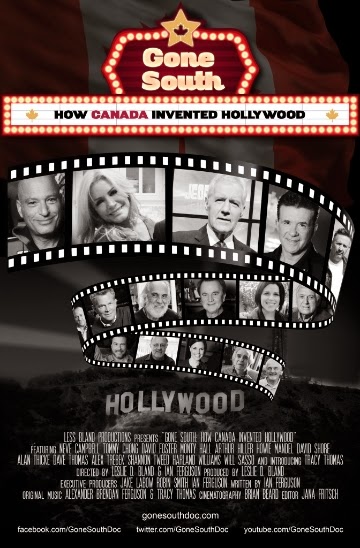
Another Reason to Blame Canada: An Interview with Leslie Bland on His Film “Gone South: How Canada Invented Hollywood”


Q:  Besides being in Hollywood, what do Louis B. Mayer and Tommy Chong have in common?  

A:  They’re Canadian.  Who knew?  You will after you see this film.

Among the terrific independent documentaries we’re screening this year is Gone South:  How Canada Invented Hollywood, a fun and insightful look at the historical and current roles that Canadians have played in our entertainment industry and pop culture.  As it turns out, Canadians have been in Hollywood, more or less in plain sight, since the earliest days of the industry—and they have stories to tell.  To talk more about the film, I spoke recently with its producer and co-director Leslie Bland. 

James Latham:  Gone South has a lot of archival material and current interviews with Canadian immigrants to Los Angeles.  Your website says that this film “presents the argument that without the slow and subversive influence of Canada, Hollywood as it is known would not and could not exist.”  That’s a pretty bold statement.  Can you briefly describe this influence?  In what ways has Canada most strongly influenced Hollywood?

Leslie Bland:  As a Canadian I would be remiss (is that a word in the US?) to not apologize for our boldness.  Sorry about that, but Canadian influence was felt from the very beginnings of Hollywood.  Al Christie from London, Ontario built the very first permanent movie studio in Hollywood in 1910.  He moved Nestor Studios from New Jersey to Hollywood, starting a stampede as the East Coast studios relocated to Los Angeles.  Other highly influential studio moguls such as Louis B. Mayer and the Warner Brothers came to LA via Canada, as did Mack Sennett.  Sennett discovered Charlie Chaplin and developed the Keystone Cops, essentially inventing comedy on film.  Of the first four Academy Award Winners for Best Actress, three were Canadian:  Marie Dressler, Mary Pickford (known as “America’s Sweetheart”), and Norma Shearer. 

JL:  Yes, there were many influential Canadians in the classical Hollywood era as well as in recent film and TV, including James Cameron, Howie Mandel, Alex Trebek, and Neve Campbell; and in other parts of the entertainment industry, such as Celine Dion and Justin Bieber.  I was actually wondering about how you’d describe the collective impacts of “Canadian-ness” on the American entertainment industry.  What sensibilities, cultural practices, or other qualities have entered and changed the Hollywood ecosystem?  Or, if you prefer to discuss a particular person, what, if anything, about James Cameron’s work screams “Canada”?

LB:  It’s hard to define a “Canadian Influence” other than I think we carry more of a world view than many Americans.  When Neve Campbell in our documentary discusses the differences between LA and Toronto, she’s also picking up on the differences in sensibilities between the two nations.  We care about how our country interfaces with the rest of the world, and how we are viewed by foreigners.  When Hollywood is viewed as “liberal” by some Americans, I think they are, in part, picking up the sometimes overlooked influence of Canadians.  James Cameron’s Avatar for instance deals with environmental themes, and Mr. Cameron, interestingly enough, has been highly critical of Canada’s oil sands developments.  He’s concerned about the earth, the environment, and, I believe, how Canada is perceived by the international community.  

Canadians bring an objectivity to pop culture.  Whereas citizens of the US are more expressive and heartfelt, we are more cerebral as a nation -- more thoughtful.  That’s where some of the politeness comes into play, but it also allows us to observe and comment without, as Harland William states, “having a stake in it.”  We feel free to make comments on American politics and culture, because, well … we’re not American.  We’ve all encountered the expression, “That’s Un-American!”  Basically, it translates as, “That’s not right!”  But in Canada we don’t wrap ourselves in the flag by saying “That’s Un-Canadian!”  We simply say, “That’s not right!”  Our national identity is not mixed up with right and wrong.  

JL:  Yes, good points.  There is something subversive in showing Americans how much Canada has shaped the U.S., as we Americans tend to ignore, belittle, or ridicule our northern neighbors.  Your film uses a lot of humor to entertain the viewer as well as soften this critique.  Has there been any noticeable difference between how audiences north and south of the border have reacted to the film?

LB:  I think Canadians find all of it amusing, because they are in on all of the jokes.  If certain Americans don’t get some of the references, again, on behalf of myself, our documentary, and our nation -- I’m sorry.  As we have an objective view of America it can be easier for us to find the humour – sorry – humor in it.   As a result, I’ve found that a US reaction to the doc can be a little less vocal. 

JL:  Along with talking about the industry, Gone South also says a lot about the experiences of all newcomers to Los Angeles.  The driving, the food, the culture....   Did you (or your crew) have any of those strange experiences or ah-ha moments here while shooting the film?

LB:  Well, I met Gene Simmons when we interviewed Shannon Tweed.  I grew up a big KISS fan, and dressed up as Gene at Halloween two years in a row, so to have the chance to meet him and Tommy Chong the very same day was surreal.  Between the ages of 9 and 11, I drove my family crazy reciting Cheech and Chong routines word for word.  

Singer / songwriter Tracy Thomas, the documentary host, got a chance to audition for David Foster.  This is captured in the doc and was not planned in advance with Mr. Foster.  He invited her back the next day to hang out with him and another Canuck, Bryan Adams, for a creative jam at his studio.  Following the session, Bryan asked Tracy and her husband to attend his concert the next evening and visit with him backstage.  

So, yeah, we experienced some unexpected, serendipitous, and memorable moments during the shooting of Gone South.  

JL:  I see that initially this project was to be a book, but instead you switched to doing a feature-length documentary.  Why?

LB:  The original idea was to put out a book.  When we pitched the book as a documentary, we picked up a Canadian broadcaster.  The film got momentum and is now complete.  The book version is still in the works.  Looks like we have a publisher interested.  

JL:  Is there anything else you’d like to mention?

LB:  David Shore was a trooper.  He was ill when we interviewed him, and you wouldn’t know based on his responses.  He said some really funny and insightful things.  

JL:    OK, thanks for your time, and for sending us your film.  

LB:    You’re welcome.  We’re thrilled it will be screening as part of The Valley Film Festival.  
---
The 14th annual Valley Film Festival takes place December 10-14, 2014, at the all-digital Laemmle NoHo 7 in North Hollywood.  For more info, visit our website or Facebook page.  Gone South:  How Canada Invented Hollywood screens at 2:30 pm on Saturday, December 13, followed by Q&A with Tracy Thomas, host of the documentary.